People who come into the shop to choose an engagement ring are usually excited, and a bit nervous. That's fine. Most of the decisions are simpler than they look, and if you go through them in order, you get to the right ring without guessing. That's how we do it with customers in the shop, and that's how we'll do it here.
Before we start: if you're not sure yet what a lab-grown diamond is, read Lab-grown diamonds: what they are and how they differ from natural diamonds first. In short, it's a real diamond grown in a lab, so you can get a bigger stone for the same budget.
Step 1: the stone shape
The shape is the first thing you see in a ring, so that's where we start. Look at the jewelry she already wears and notice what she likes: classic and round, or something a little different.
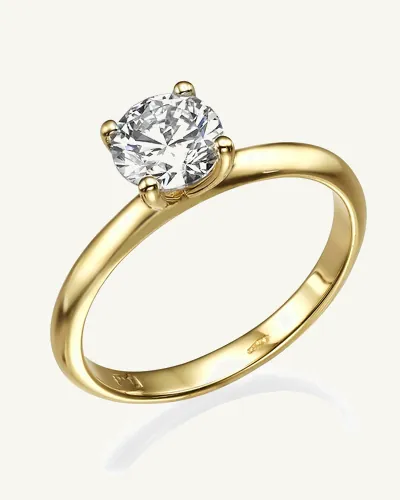
- Round. The classic shape. It returns the most light and suits almost any hand.
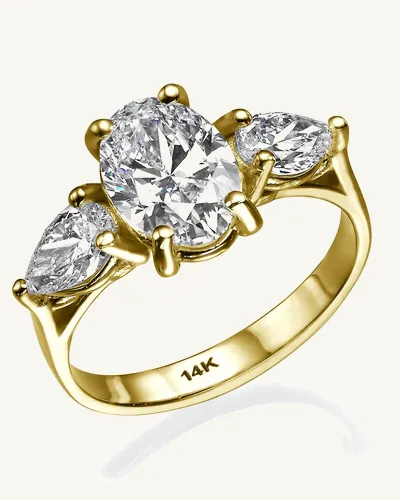
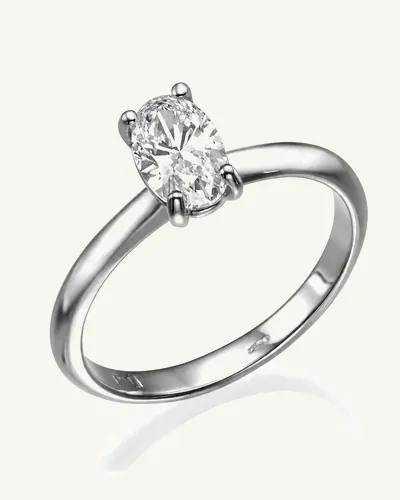
- Oval. A little elongated, so the stone looks bigger than a round one of the same weight. It also lengthens the finger.
- Pear. Round on one end and pointed on the other. Delicate and feminine.
- Marquise. Pointed at both ends, and it looks long and large.
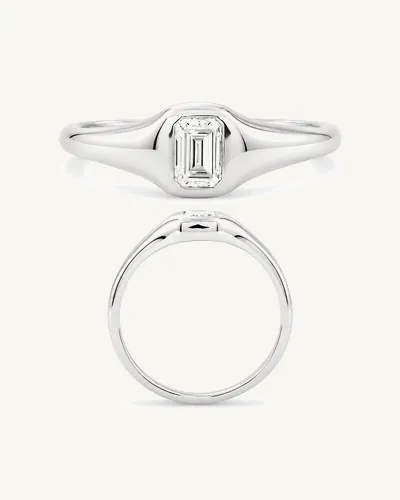
- Emerald. Rectangular with cut corners and a step cut. Less sparkle, more of a clear, elegant "mirror" look.
- Princess. Square and sparkly.
You'll find examples of all these shapes in lab-grown diamond rings.
Step 2: the setting
The setting is how the stone sits on the ring. It changes the look, and how comfortable the ring is day to day.
- Solitaire. One stone, nothing added. Clean and classic. The stone is the whole story.
- Solitaire with side stones. A center stone, with small stones along the band. More sparkle from every angle.
- Three stones. A center stone with two smaller ones beside it. Some see it as past, present and future.
- Halo. A frame of small stones around the center stone, which makes it look bigger.
A tip from the shop: if she works with her hands a lot, a lower setting will be more comfortable and catch less on clothes and hair.
Step 3: yellow or white gold
On our site, all the rings are made of 14K gold, yellow or white. 14K gold is hard enough to hold a stone securely for years, and that's one reason it's so common in engagement rings. We wrote about the difference between gold types in 14K gold.
How do you decide? Just look at what she wears today. If she mostly wears yellow gold, she'll love a yellow ring. If she wears silver tones, she'll probably prefer white. White gold brings out the whiteness of the stone, and yellow gold gives a warm, classic look.
Step 4: stone size and quality
A diamond's size is measured in carats, a unit of weight. This is where a lab-grown diamond makes the big difference: for the same budget you can choose a bigger stone than with a natural diamond.
Still, bigger isn't everything. What makes a diamond sparkle is the cut. A slightly smaller stone with a good cut will look better than a big stone with a poor cut. Color and clarity are worth a look too, but on the hand, at normal distance, the cut is what you see.
On some of our rings you can choose the stone weight on the product page and see right away how the price changes. That way you find the right balance without committing in advance.
Step 5: ring size
This is the step that stresses out anyone planning a surprise. There are a few ways to find out the size without asking, and we covered them all in How to find your ring size. You can also download our printable ring sizer.
And if it's not quite right? Under our terms, the first resize of a ring bought from us is free. So there's no need to give up the surprise because of the size.
Step 6: engraving and packaging
You can engrave a date, names, or a word only the two of you understand inside the ring. Engraving and gift wrap are on us, free of charge.
A few things to know before you order
- Delivery times. Delivery takes up to 14 business days, and usually much less. If you have a proposal date, order well ahead and tell us the date. You can also pick up from the shop for free.
- Cancellation. Under the regulations, the 14-day right to cancel applies to jewelry priced up to 3,000 ₪. A piece priced higher isn't covered. So it's worth coming to see the ring before you decide, or asking us anything that isn't clear. Full details are in the terms & conditions.
- Certificate. A gemological certificate is included only when the product page or the order confirmation says so. If it matters to you, ask first.
See the rings on your hand
An engagement ring needs to be seen on the finger. At our shop at 64 Bilu St., Rehovot you can try several shapes one after another and see what really suits. If you're coming from far away, send us a message on WhatsApp first, and we'll have the models you liked on the site ready for you.
Want to see diamond rings in other combinations too? They're all in diamond rings.
Frequently asked questions
Is a lab-grown diamond right for an engagement ring?
Yes. It's a real diamond, with the same hardness and the same sparkle, so it's made for wearing every day for years. Many couples choose it because it allows a bigger stone for the same budget.
What's the most popular diamond shape for an engagement ring?
Round is the classic, and oval and pear are in high demand. The best choice is the style she already wears.
What if the ring doesn't fit?
The first resize of a ring bought from us is free, under our terms.
Can I engrave the engagement ring?
Yes. Engraving and gift wrap are free.
How long does it take to get the ring?
Up to 14 business days, and usually much less. If there's an important date, tell us when you order.
Can I see the engagement rings before I buy?
Yes. At our shop at 64 Bilu St., Rehovot, you can try several shapes and settings. If you're coming from far away, write to us on WhatsApp first and we'll have the models you liked on the site ready.